> ## Documentation Index
> Fetch the complete documentation index at: https://domoinc-bradley-turek-pfilter-operators-reference.mintlify.site/llms.txt
> Use this file to discover all available pages before exploring further.
# Cloud Integrations Overview
Cloud Integrations provides a native integration with cross-cloud systems to unlock data products at the speed your business needs them.
## Why Cloud Integrations?
Cloud Integrations addresses the following common data challenges:
* **IT limitations** — IT alone cannot realize the full potential of data. A broad, inclusive approach across all lines of business (LOBs) is needed, and not all valuable data is under IT control.
* **Increased stress and time constraints** — Business users demand timely access to data products, increasing the pressure to deliver.
* **Rigidity and friction in data processes** — Rigid processes and tooling prevent the quick building of flexible databases, requiring too much time and effort.
## Required Grants
After Cloud Integrations is enabled for your Domo environment, you can assign the following Cloud Integrations grants to manage access to these features:
* **Manage Cloud Accounts** — Allows you to add or remove cloud accounts, manage the tables exposed by a cloud account, and choose which cloud integration a new DataSet uses (selected from Domo or any cloud integration that has been shared with you). This grant does **not** allow you to change the instance-wide default storage cloud in **Admin** > **Features** > **Cloud Integrations**. Requires the Manage DataSet grant.
* **Override Default Cloud** — Allows you to change the instance-wide default storage cloud in **Admin** > **Features** > **Cloud Integrations**. This grant does **not** allow you to change which cloud integration an individual new DataSet uses. Requires the Edit DataSet or Manage DataSet grant.
## Setup
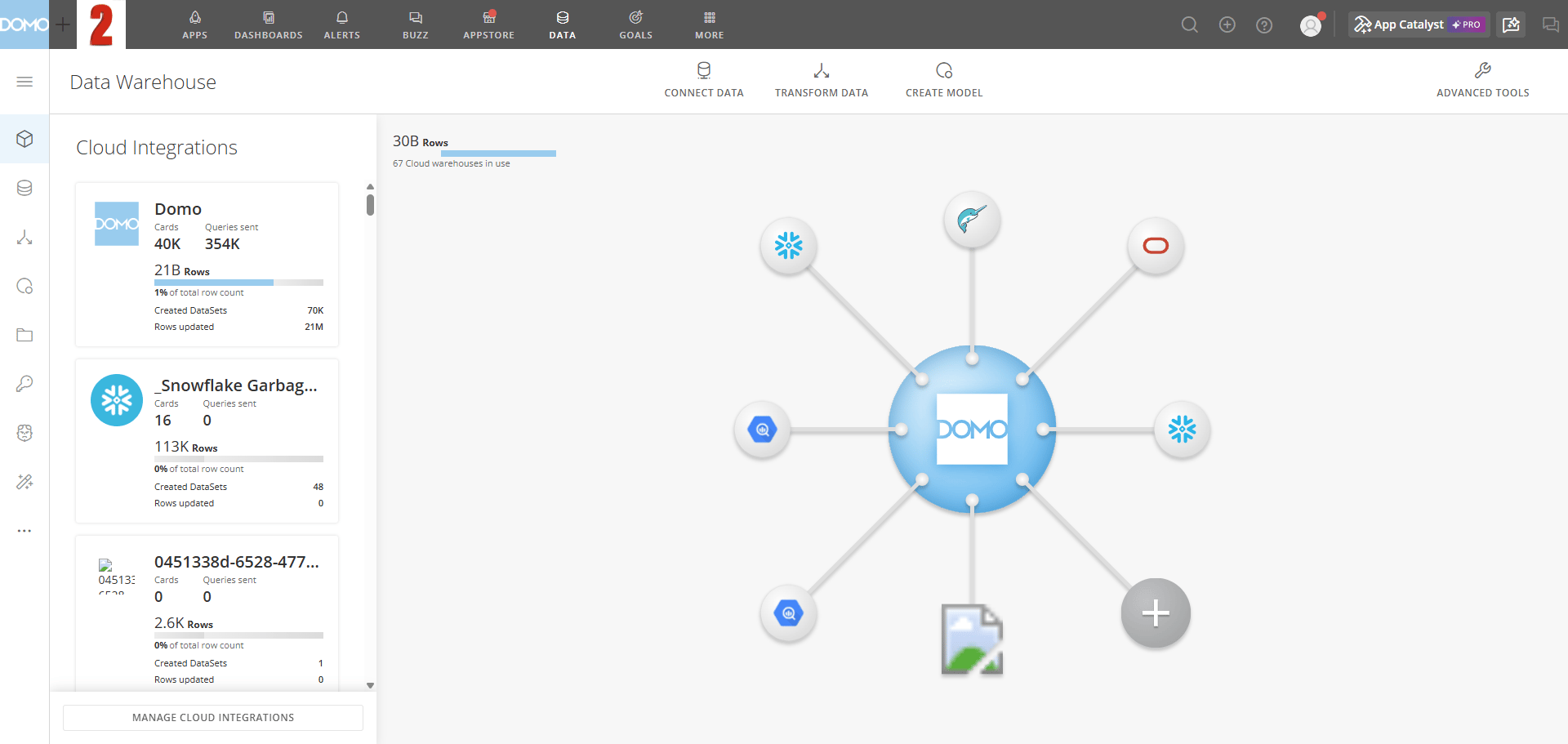
If you're on a consumption agreement, you can access Cloud Integrations from the Data Center. If not, contact your Domo account team to enable it for your instance. Once enabled, an Admin can assign the grants described above to the appropriate users before they begin connecting providers.
After Cloud Integrations is enabled for your account, you can connect your existing data warehouses. Select a provider in the table below for its setup documentation.
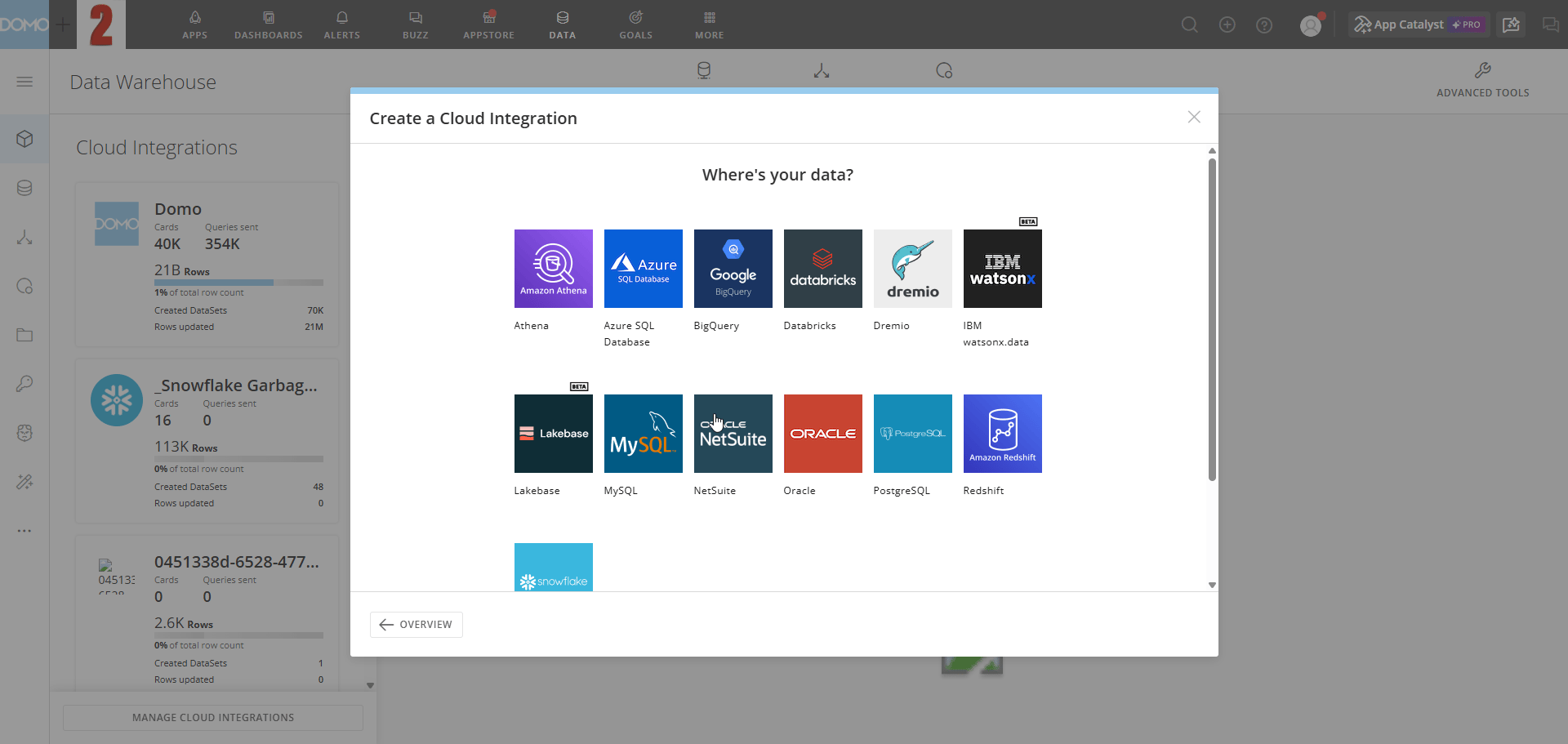 | Provider | Available support |
| ------------------------------------------------------------------ | -------------------------------------------------------------- |
| [Amazon Athena](/s/article/000005744) | Read-only |
| [Amazon Redshift](/s/article/000005312) | Read-only |
| [Azure SQL Database](/s/article/000005471) | Read-only |
| [Databricks](/s/article/000005289) | Read, Writeback, Pushdown (Beta), OAuth (read-only operations) |
| [Dremio](https://domo-support.domo.com/s/article/000005139) | Read, Writeback |
| [Google BigQuery](/s/article/000005237) | Read, Writeback, Pushdown (Beta), OAuth (read-only operations) |
| [Lakebase](/s/article/Domo-on-Lakebase) | Read-only |
| [MySQL](/s/article/000005451) | Read-only |
| [Oracle ADW](/s/article/000005586) | Read-only |
| [Oracle NetSuite](/s/article/000005586) | Read-only |
| [PostgreSQL](/s/article/000005756) | Read-only |
| [Snowflake](https://domo-support.domo.com/s/article/4402322966807) | Read, Writeback, Pushdown, OAuth (read-only operations) |
## Set a Default Storage Cloud
You can specify a default storage account for all DataSets. Changing this setting does not affect existing DataSets or DataFlows — it applies only to new assets.
**Before you begin:** You need the Override Default Cloud
[grant](#required-grants).
**Note:** We recommend setting up your Cloud Integrations connections using a
service account.
1. In the Domo navigation header, select **More** > **Admin**.
The **Admin Settings** page opens.
2. Under **Features**, select **Cloud Integrations**.
The **Cloud Integrations** page opens.
3. Select an option from the **Select the default storage cloud** dropdown.
## Best Practices
Configure all connected databases to use UTC as their time zone. When a database uses a non-UTC time zone, Domo may apply an additional time zone shift on top of the database's own offset, causing day-over-day, week-over-week, and year-over-year comparisons to return incorrect data. Databases using non-UTC time zones can also cause discrepancies between data viewed in Domo and data queried directly from the same source in other tools.
## Federated Data vs. Cloud Integrations
The table below compares federated data to Cloud Integrations read and read/write configurations:
| Capability | Federated-Direct Query | Cloud Integrations (Read-Adapter) | Cloud Integrations (Read/Write Adapter) |
| --------------------------------------------------------------------------------- | ------------------------------ | ---------------------------------- | --------------------------------------- |
| Visualize data from existing tables — Create cards, create Dashboards | ✅ | ✅ | ✅ |
| Visualize on-premise data behind firewall via an agent | ✅ | ❌ | ❌ |
| Get updated metadata from source tables — last updated time, updated row count | ❌ | ✅ (Every 15 minutes, Configurable) | ✅ (Every 15 minutes, Configurable) |
| Card Alerts | Scheduled only | ✅ (Every 15 minutes, Configurable) | ✅ (Every 15 minutes, Configurable) |
| DataSet Alerts | ❌ | ✅ (Every 15 minutes, Configurable) | ✅ (Every 15 minutes, Configurable) |
| DataSet Views | ✅ | △ (See note below) | △ (See note below) |
| Use data from existing tables in Magic ETL as inputs | ❌ | ✅ | ✅ |
| Use data updates from existing tables to trigger other DataFlows | ❌ | ✅ | ✅ |
| Custom fiscal calendar for source table data (one per instance) | ❌ | ❌ | ✅ |
| Use Domo Connectors, Workbench, SDK, CLI to write to customer-owned EDW/Data Lake | Via writeback connectors | Via writeback connectors | ✅ **Native direct rewrite** |
| Write Magic ETL output to customer-owned EDW/Data Lake | Via writeback connectors | Via writeback connectors | ✅ **Native direct rewrite** |
| PDP \| Governance | ✅ | ✅ | ✅ |
| Domo App Support | ✅ | ✅ | ✅ |
| Jupyter Workspace Support | ✅ | ✅ | ✅ |
| Domo auto-caching of card loads | Set static TTL on each DataSet | ✅ | ✅ |
**Note:** DataSet View support for Cloud Integrations DataSets is limited:
* ✅ Supported: DataSet Views (Standard Views and SQL Views) that join Cloud Integrations DataSets from the **same** cloud connection.
* ❌ Not supported: DataSet Views that join a Cloud Integrations DataSet with a Domo DataSet (a standard Domo DataSet) or with a Cloud Integrations DataSet from a different cloud connection.
When creating a DataSet View, make sure every DataSet in the join is a Cloud Integrations DataSet from the same cloud connection.
**Note:** Custom fiscal calendars are not loaded automatically when you add a new Cloud Integration. If your instance uses a custom fiscal calendar, contact Domo Support to have it loaded on the new integration.
## Share a Cloud Integrations Account
If you own a Cloud Integrations connection, you can share access to the integration and associated account so that others can help with governance of the account and underlying data. There are different levels of access available, depending on your use case.
The following table can help you determine the right level of access to grant:
| | | Read | Execute | Share | Write | Delete | Admin |
| ----------------------- | ---------------------------------------------------------------------------------- | ---------------------------------------- | ------------------------------------------ | -------------------------------- | ---------------------------------------------------------- | -------------------------------- | ----------- |
| | | Ability to register new DataSets in Domo | Ability to create new tables on the remote | Ability to share the integration | Ability to make changes to the integration and its account | Ability to delete an integration | Full access |
| **Owner** | Allows read-write use, sharing, editing, and deleting of the integration. | ✅ | ✅ | ✅ | ✅ | ✅ | ✅ |
| **Can Edit** | Allows read-write use, sharing, and editing of the integration, but cannot delete. | ✅ | ✅ | ✅ | ✅ | | |
| **Can Share** | Allows read-write use and sharing of the integration, but cannot edit or delete. | ✅ | ✅ | ✅ | | | |
| **Can Write & Connect** | Allows read-write use of the integration, but cannot share, edit, or delete. | ✅ | ✅ | | | | |
| **Can Write** | Allows write-only use of the integration, but cannot read, share, edit, or delete. | | ✅ | | | | |
| **Can Connect** | Allows read-only use of the integration, but cannot write, share, edit, or delete. | ✅ | | | | | |
| **No Access** | No access to the integration. | | | | | | |
Follow these steps to share a Cloud Integrations account:
1. In the Domo navigation bar, select **Data**, then select **Accounts** from the left sidebar.
| Provider | Available support |
| ------------------------------------------------------------------ | -------------------------------------------------------------- |
| [Amazon Athena](/s/article/000005744) | Read-only |
| [Amazon Redshift](/s/article/000005312) | Read-only |
| [Azure SQL Database](/s/article/000005471) | Read-only |
| [Databricks](/s/article/000005289) | Read, Writeback, Pushdown (Beta), OAuth (read-only operations) |
| [Dremio](https://domo-support.domo.com/s/article/000005139) | Read, Writeback |
| [Google BigQuery](/s/article/000005237) | Read, Writeback, Pushdown (Beta), OAuth (read-only operations) |
| [Lakebase](/s/article/Domo-on-Lakebase) | Read-only |
| [MySQL](/s/article/000005451) | Read-only |
| [Oracle ADW](/s/article/000005586) | Read-only |
| [Oracle NetSuite](/s/article/000005586) | Read-only |
| [PostgreSQL](/s/article/000005756) | Read-only |
| [Snowflake](https://domo-support.domo.com/s/article/4402322966807) | Read, Writeback, Pushdown, OAuth (read-only operations) |
## Set a Default Storage Cloud
You can specify a default storage account for all DataSets. Changing this setting does not affect existing DataSets or DataFlows — it applies only to new assets.
**Before you begin:** You need the Override Default Cloud
[grant](#required-grants).
**Note:** We recommend setting up your Cloud Integrations connections using a
service account.
1. In the Domo navigation header, select **More** > **Admin**.
The **Admin Settings** page opens.
2. Under **Features**, select **Cloud Integrations**.
The **Cloud Integrations** page opens.
3. Select an option from the **Select the default storage cloud** dropdown.
## Best Practices
Configure all connected databases to use UTC as their time zone. When a database uses a non-UTC time zone, Domo may apply an additional time zone shift on top of the database's own offset, causing day-over-day, week-over-week, and year-over-year comparisons to return incorrect data. Databases using non-UTC time zones can also cause discrepancies between data viewed in Domo and data queried directly from the same source in other tools.
## Federated Data vs. Cloud Integrations
The table below compares federated data to Cloud Integrations read and read/write configurations:
| Capability | Federated-Direct Query | Cloud Integrations (Read-Adapter) | Cloud Integrations (Read/Write Adapter) |
| --------------------------------------------------------------------------------- | ------------------------------ | ---------------------------------- | --------------------------------------- |
| Visualize data from existing tables — Create cards, create Dashboards | ✅ | ✅ | ✅ |
| Visualize on-premise data behind firewall via an agent | ✅ | ❌ | ❌ |
| Get updated metadata from source tables — last updated time, updated row count | ❌ | ✅ (Every 15 minutes, Configurable) | ✅ (Every 15 minutes, Configurable) |
| Card Alerts | Scheduled only | ✅ (Every 15 minutes, Configurable) | ✅ (Every 15 minutes, Configurable) |
| DataSet Alerts | ❌ | ✅ (Every 15 minutes, Configurable) | ✅ (Every 15 minutes, Configurable) |
| DataSet Views | ✅ | △ (See note below) | △ (See note below) |
| Use data from existing tables in Magic ETL as inputs | ❌ | ✅ | ✅ |
| Use data updates from existing tables to trigger other DataFlows | ❌ | ✅ | ✅ |
| Custom fiscal calendar for source table data (one per instance) | ❌ | ❌ | ✅ |
| Use Domo Connectors, Workbench, SDK, CLI to write to customer-owned EDW/Data Lake | Via writeback connectors | Via writeback connectors | ✅ **Native direct rewrite** |
| Write Magic ETL output to customer-owned EDW/Data Lake | Via writeback connectors | Via writeback connectors | ✅ **Native direct rewrite** |
| PDP \| Governance | ✅ | ✅ | ✅ |
| Domo App Support | ✅ | ✅ | ✅ |
| Jupyter Workspace Support | ✅ | ✅ | ✅ |
| Domo auto-caching of card loads | Set static TTL on each DataSet | ✅ | ✅ |
**Note:** DataSet View support for Cloud Integrations DataSets is limited:
* ✅ Supported: DataSet Views (Standard Views and SQL Views) that join Cloud Integrations DataSets from the **same** cloud connection.
* ❌ Not supported: DataSet Views that join a Cloud Integrations DataSet with a Domo DataSet (a standard Domo DataSet) or with a Cloud Integrations DataSet from a different cloud connection.
When creating a DataSet View, make sure every DataSet in the join is a Cloud Integrations DataSet from the same cloud connection.
**Note:** Custom fiscal calendars are not loaded automatically when you add a new Cloud Integration. If your instance uses a custom fiscal calendar, contact Domo Support to have it loaded on the new integration.
## Share a Cloud Integrations Account
If you own a Cloud Integrations connection, you can share access to the integration and associated account so that others can help with governance of the account and underlying data. There are different levels of access available, depending on your use case.
The following table can help you determine the right level of access to grant:
| | | Read | Execute | Share | Write | Delete | Admin |
| ----------------------- | ---------------------------------------------------------------------------------- | ---------------------------------------- | ------------------------------------------ | -------------------------------- | ---------------------------------------------------------- | -------------------------------- | ----------- |
| | | Ability to register new DataSets in Domo | Ability to create new tables on the remote | Ability to share the integration | Ability to make changes to the integration and its account | Ability to delete an integration | Full access |
| **Owner** | Allows read-write use, sharing, editing, and deleting of the integration. | ✅ | ✅ | ✅ | ✅ | ✅ | ✅ |
| **Can Edit** | Allows read-write use, sharing, and editing of the integration, but cannot delete. | ✅ | ✅ | ✅ | ✅ | | |
| **Can Share** | Allows read-write use and sharing of the integration, but cannot edit or delete. | ✅ | ✅ | ✅ | | | |
| **Can Write & Connect** | Allows read-write use of the integration, but cannot share, edit, or delete. | ✅ | ✅ | | | | |
| **Can Write** | Allows write-only use of the integration, but cannot read, share, edit, or delete. | | ✅ | | | | |
| **Can Connect** | Allows read-only use of the integration, but cannot write, share, edit, or delete. | ✅ | | | | | |
| **No Access** | No access to the integration. | | | | | | |
Follow these steps to share a Cloud Integrations account:
1. In the Domo navigation bar, select **Data**, then select **Accounts** from the left sidebar.
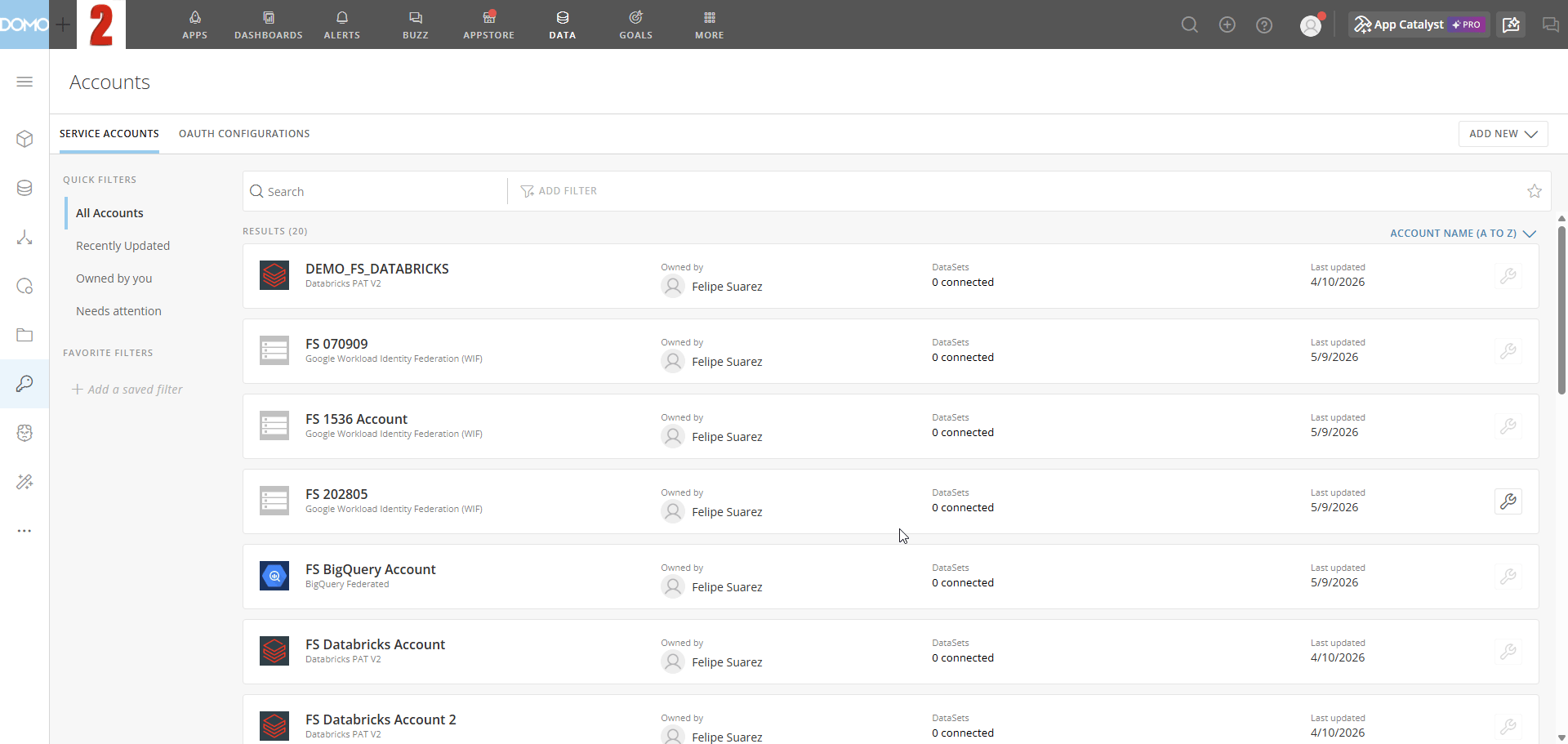 2. Find the account you want to share and select the **Wrench** icon on the right.
The options menu appears.
2. Find the account you want to share and select the **Wrench** icon on the right.
The options menu appears.
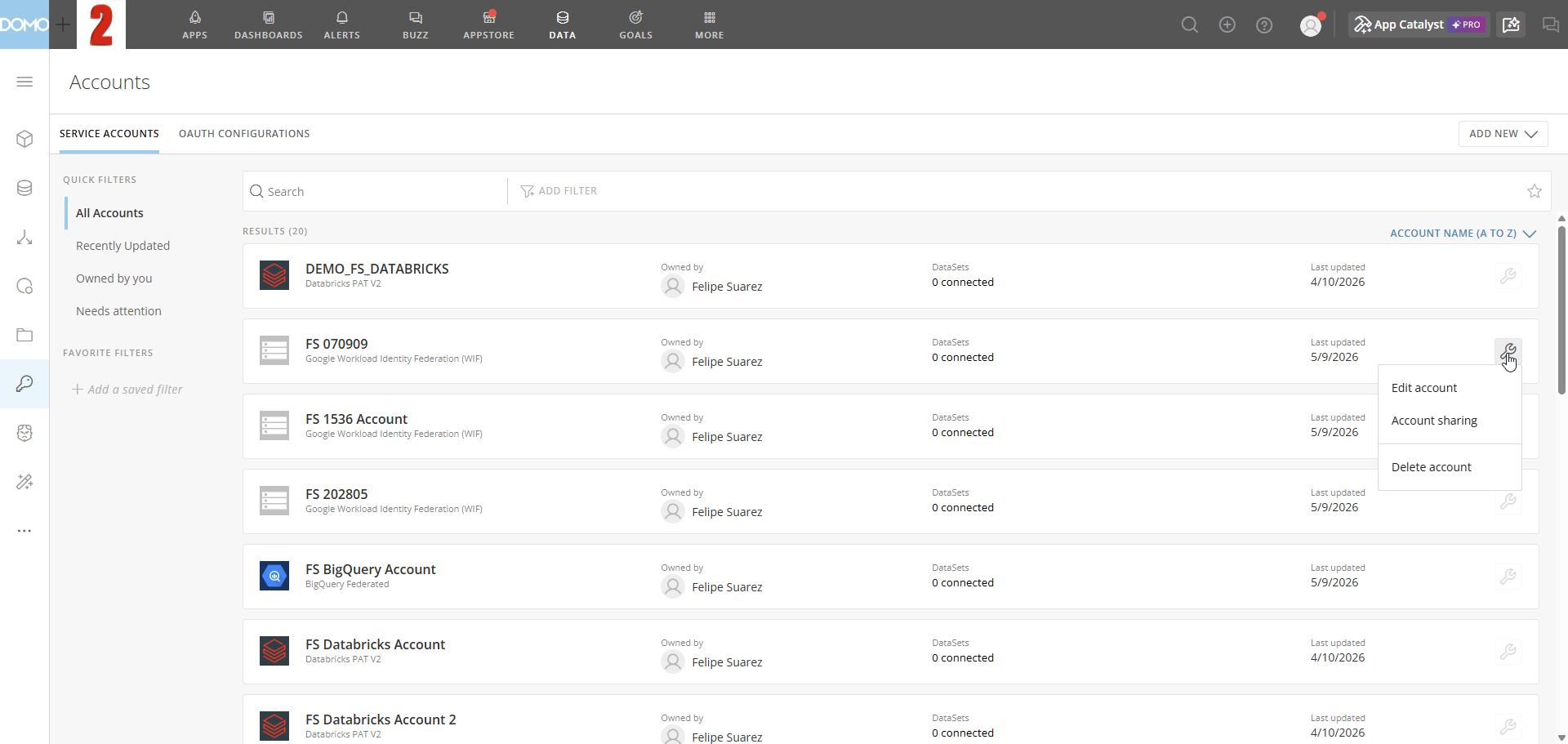 3. Select **Account sharing**.
The **Manage** *\[account name]* **access** modal opens.
3. Select **Account sharing**.
The **Manage** *\[account name]* **access** modal opens.
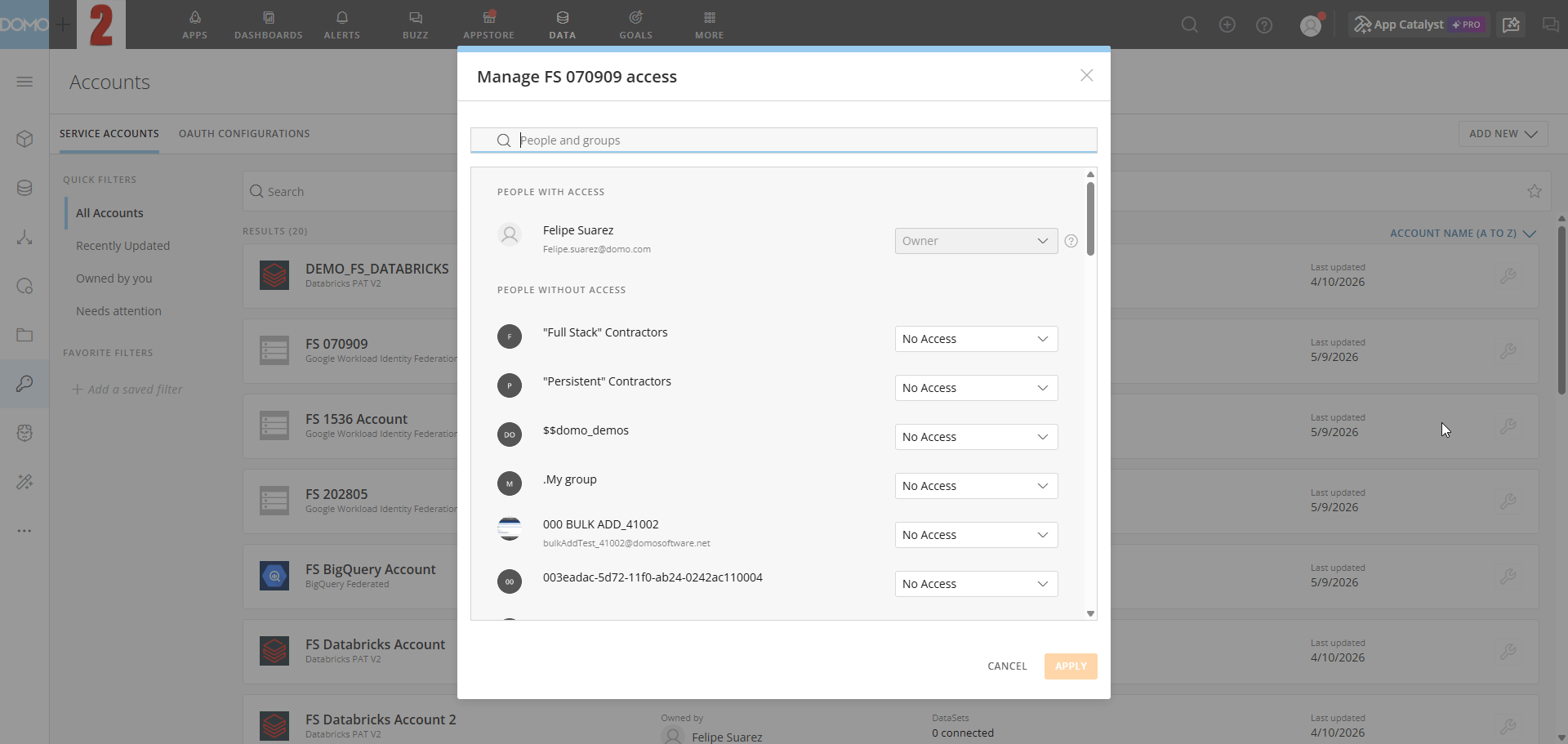 4. Find the person or group you want to share with and use the dropdown to choose the access level. The [table](#share-a-cloud-integrations-account) above can help you decide the appropriate level.
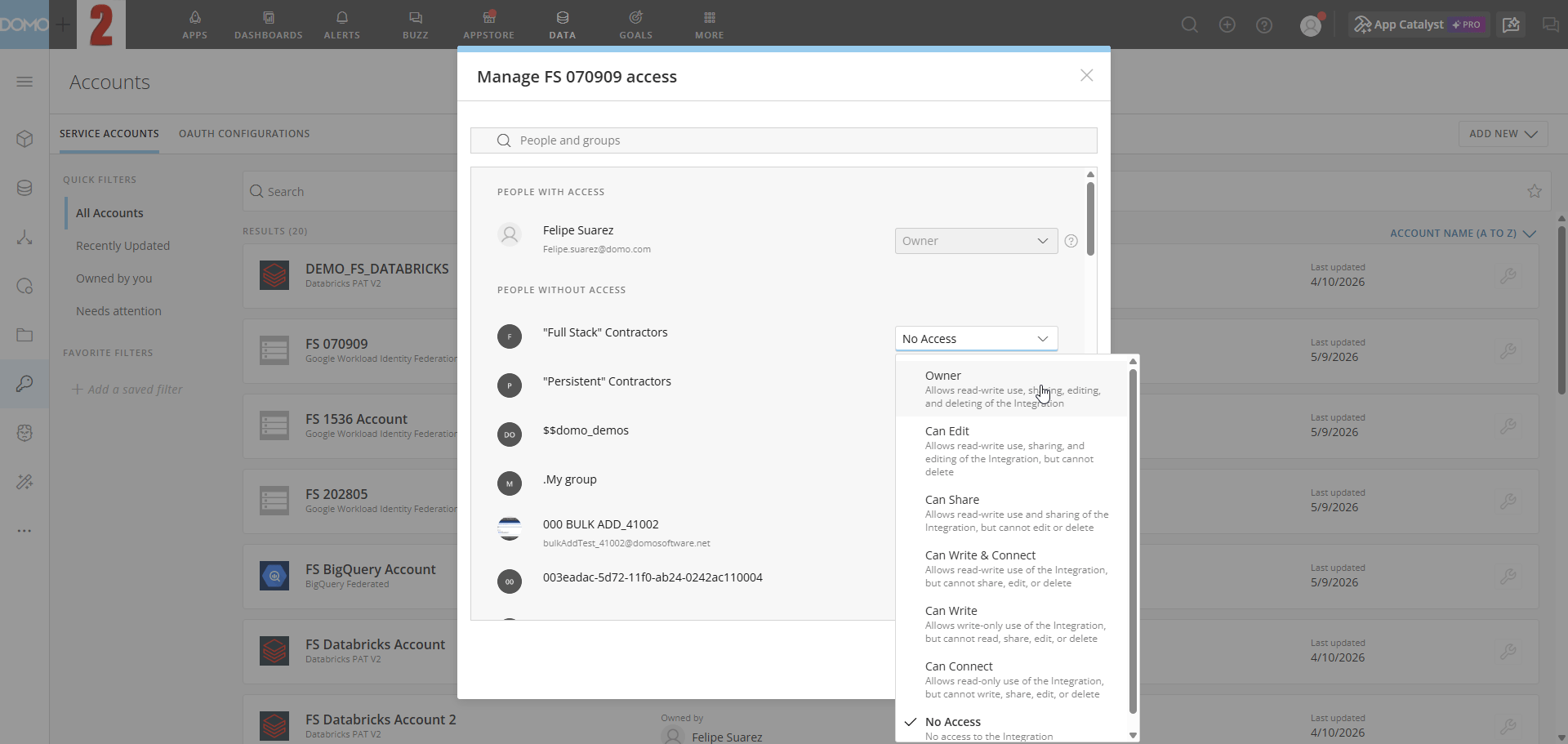 5. Select **Apply** to save your changes.
## Technical FAQ
Find answers to frequently asked questions about general topics and external cloud storage. For caching and data freshness questions, see [Configure Data Freshness and Caching in Cloud Integrations](/s/article/Cloud-Integrations-Data-Freshness).
### General
Cloud Integrations DataSets operate the same as Domo DataSets. Additionally,
Magic ETL can trigger the DataFlow to run when the data is updated in your
database.
By default, Domo checks the database metadata for updates every 15 minutes.
Magic ETL v2 supports Cloud Integrations DataSets.
You can designate DataSets created via Cloud Integrations as published
DataSets to create a virtualized DataSet in a subscriber organization. You
can then use the virtualized subscriber DataSet as an input to Magic ETL
transformations and configure it for DataSet Alerts.
You can also use DataSets created via Cloud Integrations with [Domo
Everywhere Embed](https://domo-support.domo.com/s/article/360043437993).
No.
Not currently. Support for additional locales is planned for a future release.
In the meantime, we recommend setting your locale to `en-US` when using Cloud
Integrations.
Old dates may shift by one hour due to daylight saving time (DST) adjustments.
Domo ensures correct time zone conversions for dates on or after January 1,
1970\. For dates before that, time zone adjustments may be inaccurate depending
on when daylight saving time was adopted in the relevant time zone.
When a Cloud Integrations DataSet is backed by a database View (rather than a
table), Domo does not display a row count or a last updated date. External
cloud databases do not expose row counts or modification timestamps for Views
the same way they do for tables, so Domo has no value to surface. This is
expected behavior and does not affect the DataSet's ability to power cards or
DataFlows.
### External Cloud Storage
Find answers to frequently asked questions about using Cloud Integrations with external cloud storage accounts.
Not at this time.
Not at this time.
Data Caching is available for Cloud Integrations DataSets. For more
information, see [Configure Data Freshness and Caching in Cloud
Integrations](/s/article/Cloud-Integrations-Data-Freshness).
Yes, Domo operates on your cloud warehouse account.
The method Domo uses to access a cloud warehouse account depends on the
warehouse. We recommend using a system or service account, rather than
individual user accounts, to grant Domo access to all cloud warehouses. See
the [provider setup guides](#setup) for details on how Domo accesses each
provider.
Yes. By default, you have access to both Domo's proprietary Adrenaline engine
and the Cloud Integrations engine. You can configure your Domo environment so
that only the Cloud Integrations DataSets are allowed to run in your Domo
environment, but you need to contact [Domo
Support](https://domo-support.domo.com/s/) to configure this.
For existing DataSets created via a connector or Domo APIs, contact [Domo
Support](https://domo-support.domo.com/s/) to move them to your cloud
provider. If those DataSets were created via some other method, you need to
recreate those in your cloud provider manually.
Domo's APIs can be used with any DataSet in a Domo-managed database, as long as that table is in the Domo-managed database that was configured during the write integration step of your Cloud Integrations setup. Customer-managed databases that exist in the cloud, which Domo can read but not write to, cannot be updated with Domo APIs.
This includes the Stream API, webhooks, custom apps that generate new data such as Form Builder, and managing a DataSet via the DataSet API (such as updating a DataSet, managing personalized data permissions (PDP) policies, changing the owner of a DataSet, exporting a DataSet).
For a more comprehensive guide to using the DataSet API, see the [DataSet API reference](https://developer.domo.com/docs/dataset-api-reference/dataset).
## Related Articles
* [Connect Tables in Cloud Integrations](/s/article/Connect-Tables-in-Cloud-Integrations)
* [Configure Data Freshness and Caching in Cloud Integrations](/s/article/Cloud-Integrations-Data-Freshness)
5. Select **Apply** to save your changes.
## Technical FAQ
Find answers to frequently asked questions about general topics and external cloud storage. For caching and data freshness questions, see [Configure Data Freshness and Caching in Cloud Integrations](/s/article/Cloud-Integrations-Data-Freshness).
### General
Cloud Integrations DataSets operate the same as Domo DataSets. Additionally,
Magic ETL can trigger the DataFlow to run when the data is updated in your
database.
By default, Domo checks the database metadata for updates every 15 minutes.
Magic ETL v2 supports Cloud Integrations DataSets.
You can designate DataSets created via Cloud Integrations as published
DataSets to create a virtualized DataSet in a subscriber organization. You
can then use the virtualized subscriber DataSet as an input to Magic ETL
transformations and configure it for DataSet Alerts.
You can also use DataSets created via Cloud Integrations with [Domo
Everywhere Embed](https://domo-support.domo.com/s/article/360043437993).
No.
Not currently. Support for additional locales is planned for a future release.
In the meantime, we recommend setting your locale to `en-US` when using Cloud
Integrations.
Old dates may shift by one hour due to daylight saving time (DST) adjustments.
Domo ensures correct time zone conversions for dates on or after January 1,
1970\. For dates before that, time zone adjustments may be inaccurate depending
on when daylight saving time was adopted in the relevant time zone.
When a Cloud Integrations DataSet is backed by a database View (rather than a
table), Domo does not display a row count or a last updated date. External
cloud databases do not expose row counts or modification timestamps for Views
the same way they do for tables, so Domo has no value to surface. This is
expected behavior and does not affect the DataSet's ability to power cards or
DataFlows.
### External Cloud Storage
Find answers to frequently asked questions about using Cloud Integrations with external cloud storage accounts.
Not at this time.
Not at this time.
Data Caching is available for Cloud Integrations DataSets. For more
information, see [Configure Data Freshness and Caching in Cloud
Integrations](/s/article/Cloud-Integrations-Data-Freshness).
Yes, Domo operates on your cloud warehouse account.
The method Domo uses to access a cloud warehouse account depends on the
warehouse. We recommend using a system or service account, rather than
individual user accounts, to grant Domo access to all cloud warehouses. See
the [provider setup guides](#setup) for details on how Domo accesses each
provider.
Yes. By default, you have access to both Domo's proprietary Adrenaline engine
and the Cloud Integrations engine. You can configure your Domo environment so
that only the Cloud Integrations DataSets are allowed to run in your Domo
environment, but you need to contact [Domo
Support](https://domo-support.domo.com/s/) to configure this.
For existing DataSets created via a connector or Domo APIs, contact [Domo
Support](https://domo-support.domo.com/s/) to move them to your cloud
provider. If those DataSets were created via some other method, you need to
recreate those in your cloud provider manually.
Domo's APIs can be used with any DataSet in a Domo-managed database, as long as that table is in the Domo-managed database that was configured during the write integration step of your Cloud Integrations setup. Customer-managed databases that exist in the cloud, which Domo can read but not write to, cannot be updated with Domo APIs.
This includes the Stream API, webhooks, custom apps that generate new data such as Form Builder, and managing a DataSet via the DataSet API (such as updating a DataSet, managing personalized data permissions (PDP) policies, changing the owner of a DataSet, exporting a DataSet).
For a more comprehensive guide to using the DataSet API, see the [DataSet API reference](https://developer.domo.com/docs/dataset-api-reference/dataset).
## Related Articles
* [Connect Tables in Cloud Integrations](/s/article/Connect-Tables-in-Cloud-Integrations)
* [Configure Data Freshness and Caching in Cloud Integrations](/s/article/Cloud-Integrations-Data-Freshness)